

If this is your first time reading this article, please read the article in order from item 01 to item 05.
Content
2. Where does true happiness come from?
3. True freedom
1. WHAT IS TRUE HAPPINESS?
We’re all born in this life to search for happiness.
Happiness has thousands of figures and millions of shapes but in essence, it is a kind of a feeling that we can feel by our brain. It is the opposite of suffering.
So why does our brain feel happiness?
Could it be that some kind of signal is sent to let the brain know, “Ah, I’m happy”?
Indeed, there is! These signals are called hormones and neurotransmitters — collectively known as biochemical messengers.
They are like chemical “messengers” that carry information from one cell to another,
helping the body and brain communicate and work in harmony.
There are many types of signals in the body: some bring happiness,
some convey pain, and others are neutral — neither happy nor unhappy.
In the “Happiness Team,” the key players include Dopamine, Serotonin, Oxytocin, Endorphins, Acetylcholine, etc.
– each carrying its own unique shade of joy, calmness, or connection.
On the “Stress Team,” not exactly villains but often appearing when we face pressure, we find Cortisol, Adrenaline, Norepinephrine, etc.
Our body needs both teams to survive: one helps us react and protect ourselves, the other helps us relax and restore energy. But for a truly happy life, the Happiness Team should take more of the spotlight.
For easier recall, we may call the Happiness Team the happiness hormones, and the Stress Team the suffering hormones.
So where do happy hormones and suffering hormones come from?
Knowing this secret, you will begin to walk on the way to True Happiness.
But before you know what the way to True Happiness is, you need to determine clearly what True Happiness is.
As we said, happiness has thousands of figures and millions of shapes, think-it-is-happiness things are thousands of thousands, but True Happiness is the only one.
Because it is the only one, its value is enormous, beyond every expensive thing that you could list.
But everything has its price. The way to get the highest value treasure is also the hardest.
About categorizing happiness, if considering it on the length, happiness is divided into short-term happiness and long-term happiness. If considering it in origin then happiness is divided into happiness from the outside and happiness from the inside.
Short-term happiness such as a child eating a candy, time candy eating is happy, out of candy is sad.
Long-term happiness such as the mental state of someone who has lived in their favorite place for a long time.
Happiness from outside such as a compliment from others.
Happiness from inside such as someone who has to live in a miserable place still be happy to accept it.
Mixing two of these kinds of groups, we will have a kind of short-term happiness from outside such as someone inviting you for a meal. Long-term happiness from outside such as a lifetime partner who loves you for a lifetime. Short-term happiness from inside such as you buy yourself a new shirt. So the long-term happiness from the inside is the True Happiness we are talking about: True Happiness.
True Happiness is long-term and is made by ourselves.
2. WHERE DOES TRUE HAPPINESS COME FROM?
So now combining two mentioned clues:
1. Happiness comes from happiness hormones.
2. True Happiness is long-term and is made by ourselves.
So the way to True Happiness is to answer the question: “How to make happiness hormones by ourselves for a long time?
And now it’s time to answer the question: “Where do happy hormones and suffering hormones come from?
They come from the autonomic nervous system (ANS) of our own body. The ANS will be in charge of two characters in turn are the sympathetic nervous system (SNS) and the parasympathetic nervous system (PNS). SNS often secrets suffering hormones and PNS secrets happy hormones.
So who decides which operating system is used, who decides my suffering and my happiness? Who? Who?
Who is here?
It’s you.
So how can we choose which operating system we want at the time we want?
The answer is by practicing some techniques fluently, you will be the master of your own life through all the ways that you can use words to express them.
It’s funny to get brilliant results that can be described by thousands of words, you have to go through the way of “No words”.
By practicing “NO WHISPER IN BRAIN” you will get TRUE HAPPINESS.
This way to True Happiness truly appeared more than 2000 years ago and was shown by the Greatest of the world named Buddha, now a big master named Thich Thong Triet used brain neuroscience to make clear what Buddha said.
Feel like you begin to walk on the path of more than 2000 years old to find the most valuable of all time treasure in the universe, but unfortunately, it’s dark like black pitch and you are confused and don’t know how to go,
suddenly,
Bingo,
two rows of high-pressure sodium street lights turn on so brightly.
Now you know the treasure at the end of the path just away from as a distance as your effort and persist.
Thousands of miles of road will be shortened by small steps. I hope you are on the road peacefully. You are actually on the road named “Peace”, the thing you need to do is on the road every day.

3. TRUE LIBERTY
Are you curious about what the True Happiness treasure at the end of the road looks like? It looks like True Liberty, actually, it’s True Liberty.
Among the things that bring happiness, liberty brings happiness the most. And if you want to define True Liberty, you will need more factors: doing what you like or don’t like, long-term happiness and discipline.
People often think liberty is can do what you like and don’t have to do what you don’t like. But if what you like just brings you short-term happiness and you are just able to do not have to what you don’t like in the short term, that liberty is just short-term liberty, not True Liberty.
And even worse, what you like brings you short-term happiness but long-term suffering, for example using stimulants, so you even can’t be free, you are in prison figuratively and/or literally, not like normal people.
True Liberty is a result of a choosing chain. You choose to DO what-you-do-not-like-but-bring-you-long-term-happiness, for example, sitting meditation is so much boring but good for your health. Simultaneously, you choose NOT TO DO what-you-like-but-does-not-bring-long-term-happiness, for example, you don’t sit to listen to your favorite song because you know it will create whispers in your brain which is not good.
The essence of these two things is choosing short-term suffering for long-term happiness.
If conditions allow you to do what you like which brings long-term happiness; or don’t have to do what you don’t like which doesn’t bring long-term happiness; it’s obvious and easy for anyone to choose.
Freedom which people often think of like a wild horse is allowed to anywhere he wants. But True Liberty is to domesticate that wild horse. That wild horse is like your mind, where he wants to go is your desire. Your desire is not limited, so if you can not control it, you will never feel full or long-term happiness. He will always be wandering and never find his home.
Freedom is often thought of as breaking through boundaries—but True Freedom is, in fact, the ability to maintain them. Like a levee that holds back floodwaters to protect the village, boundaries are what prevent chaos from overflowing. The key question is: which boundaries should be upheld, and which should be transcended? Any boundary that restricts the growth of Wisdom should be broken. Any boundary that restrains the growth of Greed should be preserved. But here’s the paradox:
Only by keeping certain boundaries can we truly go beyond others.
Only by keeping the precepts—restraining Greed, Hatred, and Delusion—can we transcend the boundary of Ignorance and arrive at Wisdom.
That is why the Buddha placed the path in order: Sīla (Virtue) comes first, then Samādhi (Concentration),
and only then does Paññā (Wisdom) arise.
To create True Freedom, you will need the final factor that we mentioned is discipline.
More Discipline, more Freedom. More Freedom, more Happiness.
The core of Buddhism is precepts. If the Precepts remain, the Dharma remains. If the precepts are lost, the Dharma disappears. The more precepts you keep, the more steady and your protection circle from suffering is. You can read more about the precepts we write on the link WRA3.
By finding out more about brain nerves (Link RD2), you will understand the nature of addiction is the way the brain responds to the outside environment. That’s why rehabbing at the center is easy, but coming back home and seeing addicted friends makes it easy to turn back to addiction way. Precepts are creating a new cleaning environment for the brain so it can rehab from everything of greed, anger and ignorance. Out of addiction is Complete Freedom and Complete Freedom is True Freedom – True Happiness.
4. THINGS SHOULD DO
After understanding at a glance about high-pressure sodium street lights, we recommend you are on the road every day with five actions:
1. Follow the high-pressure light from the guidance of Master Triet’s books (at link RC01) every day including: meditation sitting, no brain whispering during activities and some other techniques and requirements.
2. Walk on the ancient road of more than 2000 years old by listening to or reading Pali Tripitaka – Theravada Canon every day.
3. Keeping the Precepts as much as possible
4. Doing good things and don’t do bad things as much as possible
5. Doing more physical exercises.
4.1. Meditation
a) Meditation time
To meditate properly, you need to practice according to the instructions in Master Triet’s book. This is extremely important, so you must read Master’s book carefully. Meditating incorrectly can lead to bad results.
Sharing a bit of our real-life experience with beginner-level meditation and the body’s reactions.
If the day had been very stressful for the nervous system, then during meditation – although the mind still wandered and engaged in silent self-talk – we would yawn many times while sitting, with tears from yawning soaking the face, and after meditation, a large amount of mucus would be blown out. After the session, the body would feel lighter and noticeably less tense.
If the day had not been excessively stressful, then during meditation we would not think much. There would be brief periods with no inner verbalization at all, and we would simply observe our breathing quietly (we meditate with eyes closed). At such times, the breath became very light, almost imperceptible, and the mouth filled with saliva.
These are symptoms of the parasympathetic nervous system being activated, as explained in the book by Teacher Triet.
One meditation set is about 30 minutes to 2 hours. Best time amount for meditation with our secular life is 30 min – 1 hour in the morning and one hour at night.
Maybe at the first period, you would think why I have to spend too much time on meditation, there is many things need time to do. But after seeing amazing results which one set of meditation can bring to you, you will have different thought. You will find what thing is the most important, it will be your priority to do firstly, and because you realize its important, you will always find a time for it, other things just take time. The motto is: “Meditation first, the rest – later”.
b) Benefits of Meditation
Imagine your mind is like a silk scarf which is just tied at one end, the body part and the other end are easily blown by the wind. Or just like a pendulum fixed at one end, the body part and the other end are fluctuated from side to side. One meditation set is like a nail pinned the body part of the scarf or the pendulum that makes it hard to fly or fluctuate with small amplitude, one more meditation set is like one more nail, flying and fluctuating amplitude will be much smaller.
At the first time period, the nail will be loose and easy to break, but be patient to hit the nail with a hammer everyday, the nail will be more and more stable, hardly to remove, at that time, your concentration ability will be very stable, it’s very hard to make you fluctuate. And the top of the meditation practice is when the final nail appearances to pin the end point of the scarf or the pendulum. That’s when the mind in the state of ‘unmoving, unshakable’ which is Buddhism Wisdom that Buddha talked about.
Imagine you have a battery in your body named Imperturbable. This battery helps you to be imperturbable in your daily life. The higher the Battery level, the more Imperturbable you are in a stress situation. If this battery runs out or has never been charged, you may lose control in even a very normal circumstance. You charge this battery by Meditation every day; the longer you charge, the higher the battery level is.
E.g. 30 minutes of meditation last night just keeps you calm down for today, but if you meditate for 2 hours, it can help you calm down for 4 days even without more meditation. But if an upheaval comes which may consume completely three days of your Imperturbable Battery. So it is ideal to meditate every day. You will charge your Battery to use every day, and the unused left will be saved for the stormy days. On those stormy days, everybody is panicking because their lamps are running out of battery; when they look at you, your lamp is still so bright. It’s that light that will help you and the people around you to overcome the life storm. At that time of passing that storm, you will be surprised by how imperturbable you were.
c) Meditation in the four postures
In daily activities Buddha talked about are the four postures of walking, standing, lying down, and sitting, you should be mindful and practicing no whispering in brain when doing these four postures as in the instructions in Master Triet’s books.
In the beginning period, it will be very hard, but gradually when meditation and mindfulness in four postures which become your habit, you will find it easier and the benefits will be no needed to discuss. the benefits will be no needed to discuss but if you still want to discuss? You should find out more on Link WRA4.
4.2. Listening to or reading Pali
a) Benefits of listening/reading the Sutras
An enormous benefit habit you can make for yourself is listening to or reading Pali Tripitaka every day before sleeping.
It will make your mind settle down clouds of dust, and stresses of daily life, even strong enough to swept away that dust. You will see your breath lighter, your heart beat slower, your mind clear, light and up towards. And believe us, the content of Tripitaka is more attractive than any film or novel script that you’ve ever known. Anyway, they are the elite of universe wisdom through billions of billions of lives, so every comparison is lame.
There is just one problem: it may not be your everyday gout readings. But changing from toxic fast food to organic food is a worthy change, although it takes a little hard effort, right? But come on again, it’s worth it.
b) Time to listen/read the Sutras
We suggest you spend 1-2 hours per night for meditation. After meditating, spend 30 min – 1 hour listening to Pali. At the time of listening, you can do something like skincare, make a bed for sleep, etc. And should sleep before 10 pm. A habit spend of about 2 hours a day but we guarantee that can transform you into a completely new person on both sides physic and mentally in such a good way that you can’t even think of.
Besides listening to the Sutra before bedtime, you should listen to the Sutra whenever you feel your body tired, your mind confused or in your free time you don’t know what to do.
You will see listening to the Sutra will be the spiritual support you can find whenever you feel suffering.
Or if you are searching for a powerful tool to help you detox addiction, this is the most effective treatment. Whatever you are addicted to: drugs, alcohol, cigarettes, coffee, teas contain caffeine, social media, shopping, food, lovers, etc. While addiction begins to abuse you, you realize it. Use your strong enough mind to find one clarity second in the suffering struggle and use that clarity second to think about listening to/reading the Sutra; after that, the Sutra will help you. You only need to be strong enough to have that one second; you will find yourself very cool. And you practice and practice, that one second will come to you easily, then ten seconds, then there it goes, you quit that addiction. And you will feel how wonderful true liberty is when escaping from mind shackles.
c) How to listen/read the Sutras
Pali Tripitaka is a huge knowledge base. To listen/read all of it with the progress of a little per day, may take some years. The Sutra contains most of the teachings for monks and nuns, and a smaller part for lay people or ordinary people like us.
With the purpose for you to not be overwhelmed by units for monks and think wrongly that all Sutra is for monks, not for me and lose the chance to listen to the best value teachings, we will recommend units for ordinary people first. After listening/reading units for ordinary people, it considers as you complete the theory basic course, you can listen to all Pali Tripitaka in order of its arrangement, considering you are in the theory intermediate course (you should listen to/read the Sutta Pitaka first, then the Vinaya Pitaka, then the Abhidharma Pitaka) . About the advanced level, we don’t know about it to talk here.
For the basic course, we will suggest general units that are suitable for all kinds of ages, from children to elders, so you can read or play MP3 for your children and your elders.
In each group, both basic and intermediate, we have or introduce a summary of each lesson’s content for your convenience at the links BS1 and BS2.
This work will take a long time and we can’t work on it constantly, so the documents will be updated gradually.
All documents are in docx or pdf format, so you can easily search keywords in the search box of Word/Pdf.
You also can edit the form or fill out the content summary by yourself. This is a good way to learn and remember Pali Tripitaka.
4.3. Keeping the Precepts
In the article of Precepts at link WRA3 we quoted full of precepts in the Sutra and some of our analysis. However, to summarize to be suitable for our time, we recommend the Precept for laypersons, not monks as follows:
a) Avoid stimulants and stimulant forms
Limit maximum or cut off completely addicted entertainment ways, things or activities, including direct participation or watching/listening to such as singing, playing instruments, movies, social media, games, gambling, alcohol, coffee, tea, drugs, shopping, etc. (We mean, tea with caffeine like green tea, black tea, not herbal tea). Those addicted things that make you excited temporarily but lose homeostasis make you suffer for a long time after having fun.
After reading “Dopamine detox” at the link RD2, you may find that all pleasures have to be paid for by suffering because that’s the way your brain balances its homeostasis scale. You will have a different way of seeing pleasures; you will understand why some people choose not to pursue ordinary pleasures anymore; they are not too happy when having and not too sad when losing. They are positive to choose the balanced point of their brain scale, not push their brain to recover itself hardly.
You can also imagine your mind as a pendulum swinging between two extremes: on one side, pleasure; on the other, pain. A stimulant creates a force that pushes the pendulum off its balanced axis—toward pleasure. The stronger the stimulant, the wider the swing. So, according to natural law, will the pendulum simply return and stop at the point of balance? Or must it swing back to the side of pain with the exact same amplitude as it had toward pleasure? That is the balance of physics and also how your brain works to restore its own equilibrium. The stronger the stimulant, the greater the pleasure, the deeper the pain, and the longer it takes for the pendulum to come to rest at the balanced point.
The problem is: when the pendulum is on the side of pain – trying to rebalance itself – we can’t bear the intense suffering. We seek artificial pleasure to counterbalance the pain. We keep using stimulants to force the pendulum away from pain and back to pleasure. And just like that, we have avoided suffering, disrupted the natural recovery process, and officially stepped into the cycle of addiction.
So what is the way out of this cycle of addiction?
It is to accept suffering. To accept that horrifying period when the pendulum swings toward pain.
And something miraculous happens – each time we allow the pendulum to swing back naturally without any stimulant, it eventually moves to the side of pleasure by its own physical/chemical rhythm. And in that moment, we feel exhilarated, we feel empowered—because we resisted temptation. Then the pendulum swings back again to pain. We crave the stimulant again. But now, we’ve experienced overcoming temptation. We wait. We trust the cycle. We endure. And again, we reach the side of pleasure – this time, with even more faith in ourselves. And so it goes, until the amplitude of the pendulum’s swing gradually lessens and finally returns to its resting point of balance. No more swinging. No more craving. That’s when we are truly free.
Another dangerous aspect of addiction that we need to pay attention to is the need to constantly increase the dose of stimulation.
For example, the first time you only need to apply a “force level 1” to push the pendulum of your mind up to the joyful side at amplitude +1. Then, by natural physical law, the pendulum swings to the painful side at amplitude −1. But you cannot endure this −1 of suffering, and instead of letting it slowly return to the balance point, you want to quickly pull it back to +1. That requires a “force level 2,” meaning you must double the stimulus. The pendulum swings back to −1, and again you use dose 2. Repeating this way, you have already escalated from dose 1 to dose 2.
Yet the brain has an extraordinary capacity to adapt to both good and bad. After many uses at dose 2, the brain becomes familiar with it. Taking dose 2 no longer pushes the pendulum to joy, because the brain has reset its balance point at dose 2. That is why addicts must take that dose—not to feel pleasure, but simply to feel “normal.” And when they want to feel joy again, they must increase to dose 3, so the pendulum can swing back up to +1.
You see, at the beginning just one unit was enough for +1 of pleasure, but later they must use three times the dose just to reach the same +1. What first seemed like a cheap price for a moment of joy turns out to be extremely costly. And it doesn’t stop at 3—the longer it goes, the higher the dose, until the body reaches its breaking point.
Describing the mind as a pendulum is only a simple metaphor, not a biological model, but it reveals how addiction tightens its grip on the human mind. Unlike the circle of freedom (gained through moral discipline), the circle of addiction never widens to give more space—it only tightens, until we are left in pain and suffocating as if we cannot breathe.
Or you can read the article analyzing the dangers of Alcohol from the perspective of Developed Buddhism at link RD2 to understand clearly the dangers of Alcohol in particular and stimulants in general to our Intelligence and Karma.
Only web suffering when needing information or doing work. For example, you could go to Facebook but only find the page you want, finish reading, and you’re out, not staying on the homepage and scrolling and scrolling. Or if you need new suggesting from Facebook, you could scroll Facebook homepage but need to set up time using limit, for example only 15 minutes per day or 1 hour per week on Friday. We suggest you to limit watching TV or suffering social media because they easily create a feeling of constant information deprivation, but most of the content is stuff that is not really necessary for your mind and your inner peace.
As you gradually wean yourself off social media, TV, or games, you will feel a new energy resurrecting in your life. Suffering web or playing game which consume how much mobile phone’s battery, consume your body battery more, and more terrible, they make addictive, suck the life out of you. The body battery is instead of being terribly worn out when surfing the web or playing games, you can now use it intelligently for other benefit activities such as doing exercises, relaxing, meditation, etc. It will be very restless at the first period of quitting social media or games and you will feel extremely lethargic, depressed with good activities. This is a very normal manifestation of detoxing, but gradually the balance will tilt in a positive direction and you will find things easier, just be patient, the tunnel cannot last forever and there is definitely light at the end of the tunnel.
b) Eat and drink in moderation
The Buddha advised eating only one meal a day, before noon. This is actually very scientific, as shown by the 2016 Nobel Prize in Medicine: after at least 12 hours of continuous fasting, the body begins to activate its self-cleaning mode, as it no longer needs to focus on digesting food.
In reality, however, we are still laypeople with many responsibilities and tasks that consume a lot of energy. Eating only one meal a day is usually sufficient only for monastics in intensive practice. For various reasons, such as high work intensity or illness, we often cannot fully follow this rule. Nevertheless, we suggest finishing dinner before 7:00 PM so that the body has at least 12 hours to trigger its self-cleansing mechanism. Outside of the three main meals, avoid snacking, and dedicate one day each week to eating only one meal before noon – both to detoxify the body and to train the ability to endure hunger, strengthening resistance against greed.
c) Tell the truth
Trying to speak the truth even if it’s just a small circumstance, gradually, you will find yourself ashamed even when you just said a little white lie. If you are in a circumstance when you can not tell the truth, you can refuse to answer or try to find an answer closest to the truth. When you practice frequently to tell the truth always, you will find the truth will always find you finally. For example, someone cheated on you, as normally, you won’t be able to find out, but magically, a random situation makes you find the truth, and of course, you know there’s no random; that random was given birth when you always intentionally be honest.
d) Faithful
In relationships, try your best to remain faithful—both physically and emotionally. If you feel the relationship can no longer continue, then end it clearly before seeking someone new. Do not deceive each other. Every relationship is based on causes and conditions. Even if we cannot control the seeds we once planted, or the conditions that come from others, at the very least we can control how we handle the result. And we should handle it with honesty.
It’s simple: treat your partner the way you want to be treated. The reverse is also true: the wrongs you commit, even if you think your partner doesn’t know, sooner or later will be revealed. And even if they never find out, karma will eventually repay you in kind—someone else will deceive you, in this life or the next. The law of cause and effect is unfailingly fair and precise.
Another important point: keep boundaries in love. “Boundaries” here mean limits you set for yourself, a safety line you should not cross. Once crossed, mistakes are far too easy, and someone will be hurt.
For example: keeping a respectful distance from the opposite sex, not sitting too close unless necessary, not flirting or joking suggestively. It may sound old-fashioned, but in truth it is ancient wisdom. The saying “men and women should not be overly intimate” exists for a reason.
That reason, from the view of modern science, may lie in the neurological excitement of dopamine. If you crave the short-term highs of novelty and thrill, remember the example of the “mental pendulum”: addicts cannot stay at the same dose, they must increase it to achieve the same effect. Without self-restraint, crossing the boundary is only a matter of time.
If you think: “I only flirt to test my attractiveness, but I never cross the line or cheat,” then realize this: what appears to be confidence is actually insecurity. Because you are not truly confident, you feel the need to keep testing yourself—again and again.
A third point: beware of double standards, especially common among men. For example: “If you glance at another man, I get furious. But when I joke with another woman, you cannot be jealous, because that’s just how men are.” Double standards are a double-edged sword. She may have once loved you for the first edge: when you got jealous, she felt she was 100% important to you. But when she sees the second edge—that other women also take up a percentage of your attention—she realizes she is no longer 100%, perhaps only 80%. Naturally, her love also drops to 80%. If this continues, the love will keep falling until one day nothing remains.
Understand this: as long as there is love, there is attachment, and there is ego. We do not encourage feeding the ego with jealousy. But until you have the strength to choose “non-attachment,” at least choose “the right way to love”: faithfulness, without deception.
And ask yourself one simple question: would you want your boyfriend or girlfriend to be that close with someone else?
Keep your limits, the more you keep your limits, the better your love story will become, because you gather the water of blessings in your love story within that lake of Limits, that lake will become fuller and fuller, you do not waste the water of blessings of love everywhere, causing the water to dry up and nothing left, so that when you crave a sincere and lasting love, you look back and see that your lake has only the bottom. And do you notice that a faithful person in love is the most attractive person?
It comes from the respect for a strong person who maintains his limits to protect the person he loves from being hurt by his own mistakes. Faithfulness shows the two most precious qualities in love: knowing how to love and knowing how to protect. So if you want to always be attractive to your partner, then you should automatically choose to be faithful even though your partner cannot see it, but the Angels still see it and they will silently pour more water of love blessings into your lake.
In case you have treated your partner well but are still treated badly, then you can rest assured, when the debt is paid, you can let go and when the person leaves you, they only take away a bottle of water that you previously owed them. Your lake of love and blessing is still full and someone worthy of that lake will come to you. In case that worthy person does not come? Don’t be sad because plan B does not come, there is always plan A waiting for you. Plant a “Liberation Practice” tree by the lake and practice under its shade every day.
e) Avoid doing other bad things
Limit maximum or cut off completely: killing, taking things that are not allowed, not keeping promises (so should just promise when to have to, if circumstances prevent you from keeping your promise, you should apologize and/or find a way to make it up), divisive speech, gossip, fraud, etc.
g) Eight Precepts
To maximize the exceptional benefits of keeping the precepts, we recommend that you observe the Eight Precepts (Uposatha).
For the extraordinary benefits of practicing the Eight Precepts according to the Buddha’s teachings, please refer to link RD2.
You can keep the Eight Precepts one day per week or at least two days a month. If possible, you should go to the temple to practice the Eight Precepts because it creates a favorable environment, with little interruption or influence from external factors. If not, you can practice at home. You may choose one suitable day in the week to observe the Eight Precepts (Uposatha). The practice often begins at dawn (5–6 a.m.) on the day of undertaking the precepts and ends at dawn (5–6 a.m.) on the following day. During these 24 hours, you are to observe the following precepts:
1. Do not kill
2. Do not steal
3. Do not have any kind of sex (not practicing or thinking about)
4. Do not lie
5. Do not use stimulants
6. Do not wear makeup, dance, watch movies, etc.
7. Do not lie in a nice bed with soft blankets.
8. Avoid eating at the wrong time – only one meal a day before noon (12:00 PM)
h) Choose clean food for the soul
When you feel empty, it means you are hungry for food for your soul. Now is the time to choose clean food that does not stimulate the taste buds or dirty food that stimulates the taste buds. Just like your stomach, your soul also has a limit, if it is full of dirty food, it will not have room to eat clean food anymore. And the opposite is also true, fortunately, when you have filled your soul and mind with good information and useful activities, you will not have room or time for harmful and useless things. So every choice is an opportunity for you to change your life. Learn to be patient with the initial rough patches – because the long-term rewards often come later, not before.
When doing useful work (or at least not doing harmful work), you should do it with the mindset: Not to expect good results, but to have no time to do bad things. Working with this mindset will bring you three benefits: not wasting time waiting for sweet fruit, eating sweet fruit and not having to eat bitter fruit.
4.4. Do good deeds, avoid evil deeds
a) Do many good deeds
One important thing is you should do good things as much as possible. Although you do good things from a sincere heart without expecting returns (Seeds Class First) or from a calculating mind with expecting returns (Seeds Class Second), just do it. Because whatever seeds you sow, they still are good seeds and will create good fruits. Of course, fruits of Seeds Class First is better than Fruits of Seeds Class Second.
A sincere heart without selfish motives is too good but is a little hard to perform. Let’s take a look temporarily at doing good things with a common consciousness is a calculating mind.
Imagine you have a job, and that job gives you money; you use that money for two things: buying what you want and re-investment. All right, now that job named “Morals” means “living according to the Laws of the Universe”, details are “doing good things” meaning bringing benefit to others. When doing good things, you will earn “Blessings”. You can use these Blessings to have what you want: food, house, relationships, etc. The more Blessings you have, the more things you want you have.
But while you’re enjoying what you have, your Blessings are also drying out. You have to keep the job of doing good things to maintain that Blessing source. After that, to increase income, you’ve decided to invest. You use one part of your Blessings to invest in others, and your investment is right, so you earn a lot of returns. That’s the way Blessings give birth to Blessings at multiple rates. So what is the investment way? After doing any good thing, you pray to direct your Blessings to others so others can have Blessings like you.
You could read our Prayer When Dedicating Merits post we suggest at the link WRA2.
b) Avoid doing evil deeds
Doing evil things like loan sharks. If your job still gives you enough money to pay interest and principal gradually, your life isn’t wealthy but not miserable. But if you just do little good things, you just earn a little Blessings, you aren’t able to pay interest, so mother interest gives birth to interest, and you will sink into debt. This debt will make you suffer in one or many aspects of life depending on what kind of Blessing money debt you have. For example, if you lie, there will be someone cheating on you. If you take money, which is not allowed, someone will steal your money.
c) Blessing money
So if you want to survive in this world, you must have blessings, which means you must bring benefits to others. The more benefits you bring to others, the more valuable you are, the more blessings you have, the better your life will be. That is why people often say “The more you give, the more you receive”. If anyone does not understand the magic of time, they will see that this saying is wrong. It is true that at the moment you give, you lose something, but when time does its magical work of turning Seed into Fruit – Cause into Effect, you will understand that this saying is true, completely true, 100% true.
The interesting thing is that when we give, the recipient often thanks us – but in fact, we are the ones who need to thank them, because thanks to them we have the opportunity to sow the seeds of good Cause, so that later we can enjoy the sweet Fruit. When we realize this, humility will naturally arise in our hearts. We no longer look at beggars with contempt, but will respect them as if they were a partner, a potential entrepreneur who has accepted our investment. If they are rich, what do they need from us anymore, what chance do we have to invest? But it is best not to give with the mindset of investing, because it comes from greed and the desire to receive in return. Let’s give with empathy. We put ourselves in their shoes, if we were like them, we would be very miserable, we feel sorry for ourselves if we were like that, we understand this feeling, so naturally we feel sorry for them too.
d) The power of habit
There is a tremendous power named the power of habit. When you do bad things frequently, then gradually, you will do bad things so easily. Even if you do not think about it, you just do it. That’s a really scary thing! But you use that power of habit to do good things so the magical appearances. You will always choose to do good things even you can choose to do bad things. You do good things without considering much; you just do it, and it has become your instinct, your habit.
And look at this magical, is that you upgraded from the Seeds Class Second to Class First? You do good things without calculating or hoping for returns to yourself. You will see with the Seeds Class First, you will be in a completely different state of mind. You are no longer hoping for something to return then firstly, you are not suffering because of demand, but it’s funny that it will always come back – the good things you give away – with the recoil force which is stronger many times compared when you give – because it was strengthened by people was given by you. And it brings the beauty of purity, no selfishness; it will make you happy much more than the Seed Class Second.
e) Receiving in the Right Way
We are often taught to give, yet the other side — learning how to receive — is equally important, though seldom addressed. So, let us explore whether the Buddha mentioned anything about this in the scriptures.
Excerpt: Pali Canon / Aṅguttara Nikāya / Book of the Sixes / Chapter on Devas / Sutta 37 – Giving:
“Bhikkhus, there are three aspects on the part of the donor and three on the part of the recipient. What are the three for the donor? Before giving, the donor is joyful; while giving, their mind is clear and faithful; after giving, they feel uplifted and happy. These are the three aspects of a donor.
And what are the three aspects of the recipient? They are either free from greed or are practicing to be so; either free from hatred or are practicing to be so; either free from delusion or are practicing to be so.
Thus, there are three aspects of the donor and three of the recipient. Together, they make a gift that is complete in six parts.”
This passage from the Pāli Canon highlights the qualities of the recipient as essential conditions for the merit of the giver to fully ripen. It shows that the receiver is not merely a passive beneficiary — but an active link in the sacred chain of generosity. If the recipient is overwhelmed by greed, hatred, or delusion, even a kind-hearted donor will have their merit diminished. Therefore, when you receive mindfully, with humility and without clinging, you are fulfilling the Buddha’s teaching, and helping the giver accumulate complete merit.
So, to receive is not a position of weakness.
To receive well is to guard the virtue of the giver.
Many people find it easy to give, but struggle to receive — often out of fear of being “in debt.”
But what if we see it from another angle?
When we give, we offer someone the chance to owe us wholesome karma.
When we receive, we allow others to plant their wholesome seeds in the soil of our being.
As long as we keep our soil fertile — through virtue and mindfulness — then when others sow their good intentions into us, without our clinging or grasping, those seeds will find a home. They will grow into sweet fruit. And that fruit, first and foremost, will nourish us — before we offer it back to the world, and perhaps, even back to the giver.
But if we gently refuse their offering, denying them a chance to plant their wholesome seed, we may unintentionally cause them sadness or disheartenment. A seed of goodness wishes to be sown — but without a place to land, it withers. Over time, both the giver and the receiver miss out on the harvest.
So, receiving properly is our way of completing the two-step cycle: Sowing the seed (their act) + Creating the condition (our response) = Leading to the fruition of merit (shared result).
When you truly understand that by accepting someone’s kindness you are creating wholesome conditions, receive it with joy. Sometimes, just a heartfelt “thank you,” or a warm nod of gratitude, is already a noble act of merit.
Just remember this:
To receive in the right way — is also an act of giving.
To receive well — is to live the Dharma.
4.5. More exercise
At the time of the Buddha, the disciples were advised by the Buddha to walk, that is, to walk mindfully.
In the Pali Canon – Anguttara Nikaya, the Buddha taught the benefits of walking meditation as follows:
(IX) (29) Walking Meditation
1. – Monks, there are these five benefits of walking meditation. What are the five?
2. Patience for long journeys; patience for diligence; less illness; good digestion of food eaten, drunk, chewed, and tasted; concentration attained while walking meditation lasts for a long time. These, monks, are the five benefits of walking meditation.
That is, walking meditation has five benefits:
1. Increased endurance
2. Cultivating diligence
3. Less illness
4. Easy digestion
5. Attaining the levels of meditation.
Exercising or playing sports properly also helps us get four benefits from number 1 to number 4. When your body is healthier, you will also find your mind stronger.
Every time it is time to exercise, as long as you overcome the initial step of your mind’s laziness and unwillingness to exercise, then when you start exercising, you will find it very interesting, like you are breaking milestones in a game, a type of healthy stimulant that you are allowed to use.
5. SUPPORT TOOLS


a) Smart watch
Besides, we recommend you a super strong tool on your long trip. It’s the real thing and can wear on your hand.
It’s a smartwatch which has a Heart Rate Variety (HRV) indicator.
You can find a brand or model which is suitable for you but it should guarantee to have four following information:
1. Heart Rate: Showing your stress or relaxation level at the present second.
2. Stress level: Showing your stress or relaxation level in a day.
3. Heart Rate Variety (HRV): Showing your stress or relaxation level in a week.
4. Meditation: The watch will measure the indicators during your meditation session. Whether your meditation is effective or not will be reflected in specific numbers including: heart rate and breathing (will slow down if you meditate correctly), stress level (will decrease if you meditate correctly), battery power (may increase battery power if you meditate correctly).
You can learn about what HRV at link RD2. One thing that should be noticed is you need to wear the smartwatch most of the time and during sleep time so that HRV can be determined. Therefore, let’s find a smartwatch that is light enough and comfortable so that you can accept it by your side in your sleep.
In addition, this is also an extremely useful support tool to measure health and other sports activities.
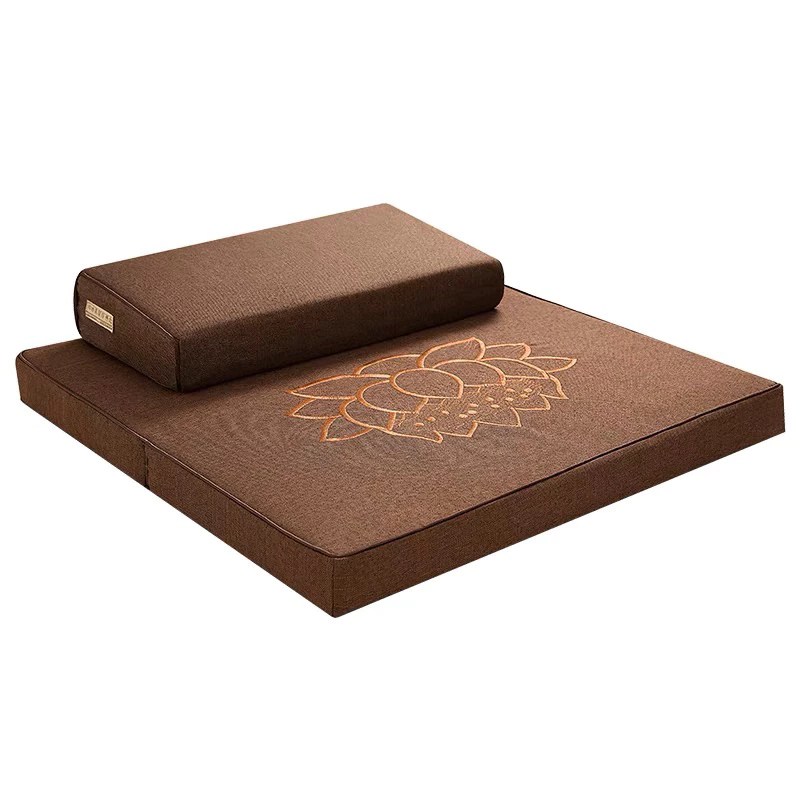
b) Meditation cushion and soundproof headphones
When meditating, you will need two more support tools. The first is a set of cushions including a cushion, an armrest and a backrest. You should choose a backrest like a long cushion, to avoid slipping when sitting, made of coconut fiber (as shown in the above picture). The second is a soundproof headphone, you will minimize distracting noise, you can even hear your heartbeat and breathing, it reflects whether you are relaxing to meditate or still stressed (see above picture).
c) Translation tools
Due to our limited time and translation capacity and/or copyright issues to ensure the accuracy of the language and avoid biased thinking, most of the documents introduced are in Vietnamese, a few are also in English, we cannot translate books/documents into your language, so you have to find your own way to understand the documents in your language. Use Google Translate (this method is often not very accurate but sometimes it is the best way within your ability), hire professional Buddhist translators,… You can contact directly with the Tanh Khong Zen Association which holds the copyright of Master Triet’s books.
Or you can read our recommendations in the “Guide to reading multilingual materials” section on the homepage of this website.
Put in the effort and you will find it worth it!
P/S: If you have translations of books or documents we mention on this website translated into other languages and approved by the author or copyrighted, please contact us at “Contact“ form on the home page, so that we can post additionally on this website. Thank you very much!
 thewaytotruehappiness.org
Leave a comment